

Market Report · Southern OntarioJuly 2026 Southern Ontario Real Estate Market Report: What's Really Happening Across the GTA And Surroundings📅 Published August 7, 2026📊 Based on July

Niagara Falls at night: Ontario's ambitious "Vegas of the North" vision is transforming the region into a year-round entertainment and investment destination.
Ontario's Vegas of the North: Why Niagara Is Becoming a Real Estate Investment Hotspot
How the Destination Niagara Strategy is creating a strategic entry window for residential and commercial investors
📊 Milton & GTA Market Snapshot 2026
Milton Average Home Price: $1,050,000 | GTA Average: $1,150,000
Milton Detached Homes: ~$1,250,000 | Townhomes: ~$900,000 | Condos: ~$620,000
Active Listings (Milton): 600-700 properties | Days on Market: 25-30 days
First-Time Buyer Demand: High across Milton, Oakville, Mississauga, and Toronto
Investment Opportunity Score: Strong for buyers looking beyond GTA core
Source: Royal Canadian Realty Market Analysis, January 2026
According to Royal Canadian Realty's 2026 market analysis, GTA buyers from Milton, Oakville, Mississauga, and Toronto are increasingly exploring investment opportunities beyond the traditional core markets—and Ontario's "Vegas of the North" Niagara transformation represents one of the most compelling policy-backed opportunities for first-time buyers and investors alike. Niagara is no longer just a place to visit for a weekend. Ontario is now formally repositioning the region as a year-round economic engine under the new Destination Niagara Strategy—a multi-billion-dollar push Premier Doug Ford has framed as creating the "Vegas of the North." For residential and commercial real estate investors, this represents a classic moment where long-term public policy, infrastructure, and tourism investment are beginning to move ahead of full real estate repricing across Niagara Falls, St. Catharines, Welland, Fort Erie, and Niagara-on-the-Lake.
This is not speculative hype. The province's 2025 budget allocates tens of millions of dollars to Destination Niagara over several years, including at least $35 million for new attractions, enhanced cultural offerings, and better air access. When governments commit this level of capital and policy focus, sophisticated investors recognize a pattern: infrastructure and employment investment arrives first, and only later does the full re-rating of land, housing, and commercial assets show up in price data and cap rates.
What "Vegas of the North" Really Means
The "Vegas of the North" language is shorthand for a much broader transformation of Niagara Falls and the surrounding region into a diversified, year-round entertainment, hospitality, and tourism economy. The province has highlighted potential developments such as additional casinos, a major theme park, a landmark observation wheel, and the conversion of the historic Toronto Power Generating Station into a five-star hotel and visitor hub—all designed to keep visitors in Niagara longer and spending more.
These investments are layered on top of existing strengths in wine, culinary tourism, and cultural institutions like the Shaw Festival in Niagara-on-the-Lake. But the critical shift is this: the strategy is about moving beyond purely seasonal tourism. Ontario's own framing emphasizes year-round attractions and enhanced transportation, explicitly connecting tourism growth with job creation and long-term investment in the region's infrastructure.
Key Insight: More permanent, stable employment in sectors like accommodation, food services, retail, culture, and logistics shifts Niagara from a "visit and leave" market to a "visit, move here, and build a business here" economy—fundamentally altering the underlying real estate demand profile.
Premier Doug Ford has explicitly stated that Niagara has the potential to be a "world-class destination that drives Ontario's economy and keeps tens of thousands of workers on the job," with an ambition to attract 25 million visitors per year and add roughly $3 billion to provincial GDP. This reinforces a view shared by many investors: Niagara is evolving into a year-round economy anchored by predictable visitor flows and permanent jobs, not just summer traffic.
Ontario's Investment Signals and Policy Alignment
The Destination Niagara Strategy is not an isolated announcement. It is nested within Ontario's broader economic and infrastructure agenda, creating multiple layers of policy alignment that reduce long-term "policy risk" for private investors.
Transit and Transportation Infrastructure
The province and federal partners have already committed tens of millions of dollars to Niagara transit, including nearly $43 million to purchase 124 new buses and upgrade public transit across the region. They continue to advance GO Transit expansion along the Lakeshore West line into Niagara Falls, St. Catharines, and Grimsby.
Metrolinx and Niagara Region are actively planning station-area intensification and transit-oriented development around these GO nodes, embedding real estate into the transit plan itself. At the same time, Ontario and Niagara Region are moving forward on major road and bridge projects—such as twinning the Garden City Skyway and expanding the QEW—within a broader Destination Niagara infrastructure package aimed at supporting higher traffic volumes and freight movement.
Regional Growth Planning
These commitments align with the Niagara Official Plan, which is planning for 694,000 people and 272,000 jobs by 2051, along with an additional 855 hectares of developable land to accommodate residential and employment growth. For investors, this combination of provincial capital, regional land-use planning, and tourism policy significantly reduces long-term policy risk and signals that private investment is being invited into a framework designed to support growth rather than constrain it.
| Infrastructure Investment | Status | Real Estate Impact |
|---|---|---|
| GO Transit Expansion (Lakeshore West) | Planning/Construction | Transit-oriented development, station-area intensification |
| $43M Transit Fleet Upgrade | Funded/Active | Improved regional mobility, job access |
| Garden City Skyway Twinning | Planning | Reduced congestion, freight efficiency |
| QEW Expansion | Planning | Enhanced regional connectivity to GTA |
Why Public and Investor Confidence Is Building
Public messaging from the Premier, Niagara Region, and local municipalities consistently frames the Destination Niagara Strategy as both a tourism initiative and an economic development plan. This dual framing matters because it signals to investors that the region is being repositioned for permanent economic transformation, not just seasonal tourism bumps.
Local economic analyses back up this sentiment. Niagara's recent labour market updates show population growth driven by migration, particularly among working-age adults 25-44, and employment gains in accommodation, food services, and wholesale and retail trade—all of which are directly linked to tourism and service-sector expansion.
Investor Pattern Recognition: As governments increase capital spending and policy attention, sophisticated investors tend to see this as a signal that government investment unlocks private capital, encouraging early positioning in residential, commercial, and mixed-use assets before the broader market fully prices in the new trajectory.
Residential Real Estate Impact: Why Housing Demand Rises
Population growth is already underway. Niagara's population rose from roughly 454,000 in 2016 to about 485,000 in 2021, a 6.8% increase that outpaced the provincial average. The region now expects to add more than 214,000 residents by 2051 under its growth forecast.
The Niagara Official Plan and city-level planning explicitly anticipate tens of thousands of new residents and jobs. For example, Niagara Falls' new Official Plan to 2051 projects about 47,250 additional residents and over 20,000 new housing units, plus 17,000 new jobs.
Rental Market Fundamentals
Rental market data underscores the demand story. CMHC's rental market reporting shows that the St. Catharines–Niagara CMA has experienced rising average rents and tight vacancy rates, with recent years seeing vacancy near or below historical norms even as purpose-built rental stock expands.
For investors comparing Niagara to the GTA, the region offers a combination of lower entry prices and improving rental fundamentals, making it attractive for long-term holds, purpose-built rentals, and well-located secondary suites, while still appealing to first-time buyers, downsizers, and end-users seeking more affordability without sacrificing access to jobs and transit.
Key Takeaway: When employment stabilizes and grows, housing demand typically follows—and Niagara's policy framework is intentionally pushing in that direction. This creates a favorable environment for residential investors who position early in growth corridors.
Ready to Explore Niagara Investment Opportunities?
Team Home Axe | Royal Canadian Realty Brokerage
Muhammad Ather, Broker — 416-877-4129
Ali Qureshi, Realtor® — 647-671-2880
Email: teamhomeaxe@gmail.com
Website: www.homeaxe.com
Sharp Moves • Smart Homes.
Commercial and Mixed-Use Real Estate Opportunities
On the commercial side, the Destination Niagara Strategy directly supports retail, hospitality, and entertainment-adjacent real estate. Plans for more casinos, a theme park-scale attraction, a landmark observation wheel, and a five-star hotel at the Toronto Power site are expected to increase length of stay and daily spend per visitor.
This, in turn, supports restaurants, shops, personal services, and entertainment venues across Niagara Falls and into surrounding communities like St. Catharines and Niagara-on-the-Lake. Ontario is also investing in cultural and wine-tourism infrastructure, including funding for new attractions and support for regional festivals and venues, reinforcing the draw of mixed-use districts.
Beyond Tourism: Logistics and Professional Services
Beyond core tourism nodes, logistics, warehousing, and professional services stand to benefit from improved transportation corridors and GO connectivity to the GTA. Niagara Economic Development data show a diversified labour force with meaningful employment in management, health, education, manufacturing, and recreation sectors, demonstrating that the region is not solely dependent on tourism.
For investors, year-round foot traffic and more stable employment underpin the viability of street-level retail, neighbourhood service plazas, and office or flex-space tied to tourism supply chains and local professional services.
Niagara's Next Boom: What the Data Signals
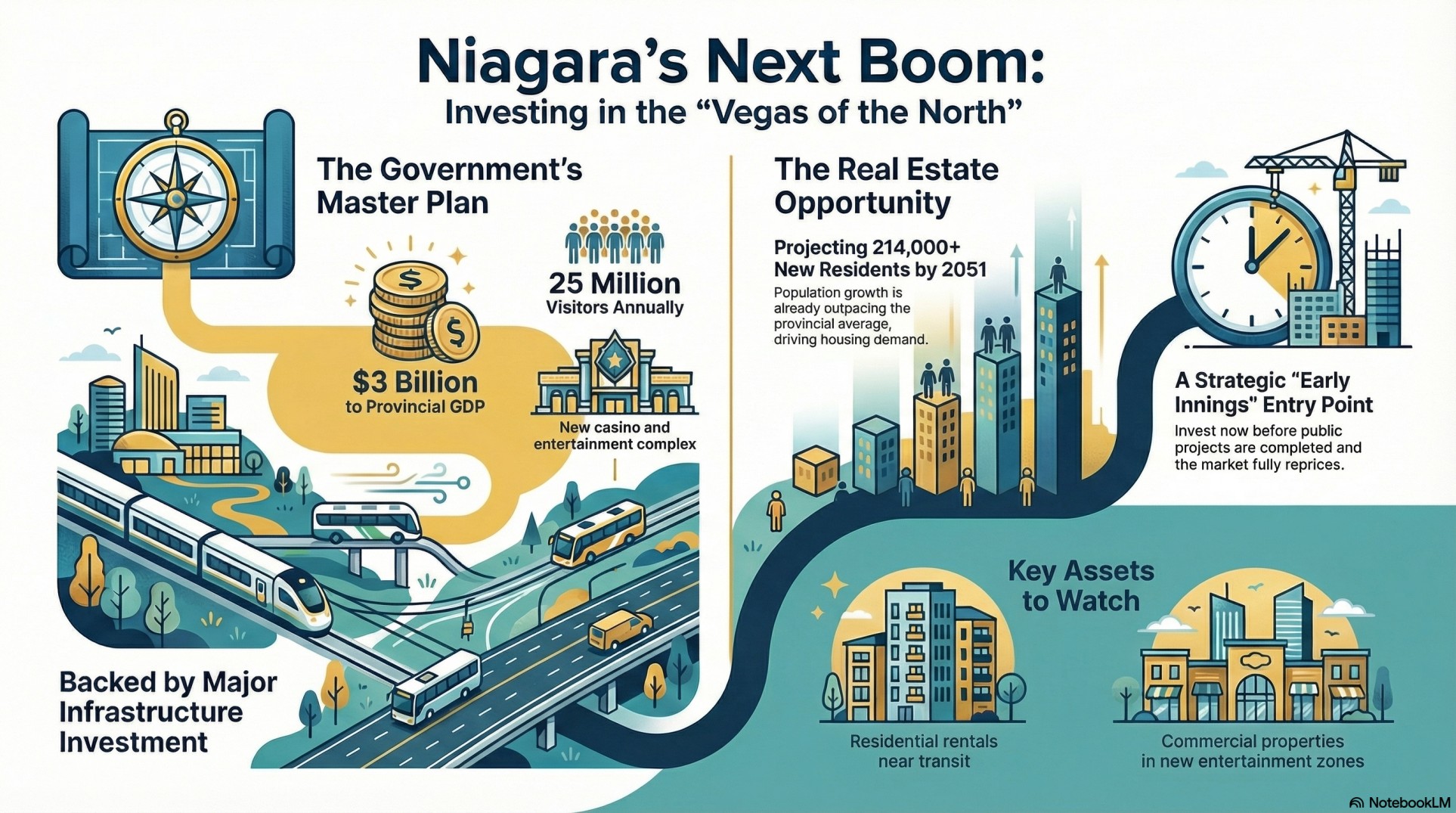
Key metrics and opportunities: Ontario's Destination Niagara Strategy is creating a data-driven investment case across residential and commercial real estate.
The combination of policy commitment, population growth, infrastructure investment, and employment expansion creates a compelling data-driven investment case. Let's break down the numbers:
- Target visitor growth: 25 million visitors annually (up from current levels)
- Economic impact goal: $3 billion addition to provincial GDP
- Population projection: 694,000 people by 2051 (from ~485,000 in 2021)
- Job creation target: 272,000 jobs by 2051
- New developable land: 855 hectares designated for residential and employment growth
- Niagara Falls alone: 47,250 additional residents, 20,000+ new housing units, 17,000 new jobs
These aren't aspirational figures. They're embedded in official regional plans, supported by provincial budget allocations, and backed by concrete infrastructure projects already underway or in advanced planning stages.
Investment Principle: Markets typically reprice assets once infrastructure is visible and employment growth is confirmed. Investors who wait for complete certainty often buy into already re-rated markets. The current window represents an "early innings" opportunity where policy direction is clear, but pricing still reflects legacy perceptions of Niagara as mainly seasonal.
Why Timing Matters: Niagara Today vs. Niagara Tomorrow
Today's Niagara is in a transition phase: policy and capital commitments are public and detailed, but the full cycle of private development, job growth, and rent/price appreciation is still unfolding. The Niagara Official Plan's growth targets to 2051, combined with the province's multi-year budget support for Destination Niagara and ongoing transit expansion, represent a classic "early innings" stage.
Historically, in Ontario and other jurisdictions, those who invest during this policy-led build-out phase often secure more favorable entry prices and stronger long-term upside than those who wait for complete certainty.
What Happens When Projects Come Online
Waiting for every attraction, hotel, and transit project to be completed before acting typically means buying into a re-rated market. As major elements of Destination Niagara come online—such as the Toronto Power hotel, new attractions, upgraded transit, and expanded QEW capacity—Niagara's appeal as a place to live and invest is likely to become more widely recognized.
This recognition typically manifests as narrowing spreads versus core GTA markets and compressing yields on the most desirable assets. For disciplined investors, the present moment should be viewed as a strategic entry window, not a speculative rush: a period where fundamentals are strengthening, policy direction is clear, but pricing still reflects legacy perceptions.
Risks, Timelines, and Reality Check
A credible investment thesis must acknowledge risk. The Destination Niagara transformation will unfold over many years, not months, and timelines for large infrastructure, transit, and tourism projects can shift with economic conditions, procurement realities, and political cycles.
Project Execution Risk
While the province has laid out clear pillars and budget envelopes, individual projects—such as a theme park, new casinos, or specific cultural venues—will still depend on successful private-public partnerships, environmental approvals, and market demand. This means not every announcement will materialize exactly as envisioned.
Location and Asset Selection Matter
Not every property will benefit equally. Assets closest to transit nodes, entertainment districts, waterfronts, and designated growth centres—such as downtown St. Catharines, parts of Niagara Falls, and Welland's regional growth centre—are more likely to capture the strongest rental and capital growth.
Outlying or poorly-located properties may see more modest gains. Regulatory considerations also matter: investors must track evolving rules on short-term rentals, secondary suites, commercial zoning, and intensification, as municipal planning in Niagara Falls, St. Catharines, Fort Erie, and Niagara-on-the-Lake increasingly aims to balance growth with livability and housing affordability.
Reality Check: Policy is a tailwind, but asset selection, micro-location, and zoning literacy will determine actual investment outcomes. Working with advisors who understand zoning, transit planning, and the nuances of each Niagara sub-market becomes a risk-management tool, not just a convenience.
Strategic Investor Takeaways
Taken together, Ontario's Destination Niagara Strategy, the Niagara Official Plan, and the region's labour-market and demographic trends show that Niagara's transformation is policy-backed and data-supported, not just marketing language. The province is explicitly targeting more visitors, more jobs, and more infrastructure, while Niagara Region is planning for hundreds of thousands of additional residents and significant employment growth by 2051.
For Residential Investors
Residential assets in Niagara Falls, St. Catharines, Welland, Fort Erie, and Niagara-on-the-Lake stand to benefit from growing population, tourism-linked employment, and relative affordability compared with the GTA. Priority asset classes include:
- Purpose-built rentals near GO stations and major employment nodes
- Multi-unit properties in designated intensification zones
- Well-located freehold homes with strong rental appeal or conversion potential
- Properties within walking distance of emerging entertainment districts
For Commercial Investors
Commercial and mixed-use properties near planned and existing attractions, GO stations, entertainment districts, and key corridors are leveraged to rising foot traffic and a broadening year-round economy. Focus areas include:
- Retail and hospitality assets along entertainment corridors
- Mixed-use developments in downtown cores
- Logistics and warehouse space along expanded transportation routes
- Professional service space benefiting from tourism supply chains
The Strategic Positioning Principle
Early, informed positioning—grounded in policy review, municipal plans, and rental/price data—offers a higher probability of capturing upside as Niagara's "Vegas of the North" strategy moves from announcement to execution, without relying on speculative hype.
Frequently Asked Questions
What does "Vegas of the North" actually mean for Niagara real estate investors?
"Vegas of the North" is shorthand for Ontario's comprehensive strategy to transform Niagara into a year-round entertainment, hospitality, and tourism economy. For real estate investors, this means shifting fundamentals: more permanent jobs, stable visitor flows, improved infrastructure, and growing population. The strategy includes plans for additional casinos, a major theme park, observation wheels, luxury hotels, and enhanced transit—all designed to extend visitor stays and support residential and commercial demand across the region.
How much is Ontario actually investing in Destination Niagara?
Ontario's 2025 budget allocates at least $35 million specifically for Destination Niagara attractions, cultural offerings, and air access improvements, with additional tens of millions committed to transit infrastructure including $43 million for 124 new buses. The province is also funding GO Transit expansion, QEW improvements, and Garden City Skyway twinning. These investments span multiple years and represent a long-horizon commitment to repositioning the region's economic base.
Which Niagara cities offer the best investment opportunities right now?
The strongest opportunities cluster around transit nodes, designated growth centres, and entertainment districts. Niagara Falls remains the primary tourism and development focus, but St. Catharines offers downtown intensification potential with GO connectivity, Welland presents a regional growth centre with lower entry prices, and Fort Erie and Niagara-on-the-Lake benefit from cultural tourism and wine country appeal. Asset selection and micro-location matter more than broad city-level choices—proximity to GO stations, walkability to attractions, and zoning flexibility drive returns.
Is Niagara's population actually growing, or is this just tourism speculation?
Population growth is confirmed and accelerating. Niagara's population rose 6.8% from 2016 to 2021 (454,000 to 485,000), outpacing Ontario's average. The Niagara Official Plan projects 694,000 people by 2051, adding over 214,000 residents. Niagara Falls alone expects 47,250 additional residents and 20,000+ new housing units by 2051. This growth is driven by migration of working-age adults (25-44) and employment expansion in accommodation, food services, and retail—not just seasonal tourism.
What are the biggest risks to Niagara's "Vegas of the North" transformation?
Key risks include project timeline delays (infrastructure and tourism projects often take longer than announced), execution risk on private-public partnerships, changing economic conditions affecting tourism demand, and regulatory shifts around short-term rentals or intensification. Not every announced attraction will materialize as envisioned, and not every property will benefit equally. Outlying locations may see modest gains while transit-oriented and entertainment-adjacent properties capture the strongest upside. Political cycles and procurement realities can also shift timelines.
How does Niagara's rental market compare to the GTA?
Niagara offers lower entry prices with improving rental fundamentals. CMHC data shows the St. Catharines–Niagara CMA has experienced rising average rents and tight vacancy rates (near or below historical norms) even as purpose-built rental stock expands. Compared to core GTA markets, Niagara provides better cash flow potential for landlords while still offering tenants relative affordability. As GO Transit expansion improves GTA connectivity, Niagara becomes increasingly viable for commuters, supporting rental demand from working professionals.
When is the best time to invest in Niagara—now or after projects are completed?
Historically, investors who position during the policy-led build-out phase secure more favorable entry prices than those who wait for complete certainty. Today's Niagara represents an "early innings" stage: policy direction is clear, infrastructure funding is allocated, and growth projections are official, but pricing still reflects legacy perceptions of seasonal tourism. Waiting for every attraction, hotel, and transit project to be completed typically means buying into an already re-rated market. The strategic entry window exists now, during the transition phase before broader market recognition fully reprices assets.
What types of commercial real estate will benefit most from Destination Niagara?
Retail, hospitality, and entertainment-adjacent commercial properties near planned attractions, GO stations, and entertainment districts will see the strongest impact. Street-level retail along main corridors, neighbourhood service plazas in growing residential areas, mixed-use developments in downtown cores, and logistics/warehouse space along improved transportation routes all stand to benefit. The strategy's emphasis on year-round activity and extended visitor stays supports restaurants, shops, personal services, and professional office space tied to tourism supply chains. Assets with walkability to attractions and transit capture premium value.
How important is working with a local Niagara real estate expert for investment success?
Critically important. Success in Niagara depends on understanding zoning nuances, transit planning timelines, municipal intensification policies, and micro-location factors that vary significantly across Niagara Falls, St. Catharines, Welland, Fort Erie, and Niagara-on-the-Lake. Working with advisors who track regional official plans, station-area development, and evolving regulations on short-term rentals and secondary suites becomes a risk-management tool. Policy is a tailwind, but asset selection, micro-location, and zoning literacy determine actual returns. Generic GTA investment strategies don't translate directly to Niagara's unique market dynamics.
📌 Final Thoughts
Niagara is entering a new chapter where tourism, infrastructure, and economic development policy are deliberately aligned to create sustained, year-round activity across the region. The combination of the Destination Niagara Strategy, GO expansion, major road investments, and a growth-focused Official Plan points to a long-term shift in how Niagara Falls, St. Catharines, Welland, Fort Erie, and Niagara-on-the-Lake will function as residential and commercial markets within Southern Ontario.
In this context, real estate success will come from timing plus execution: recognizing the current window as a strategic entry point, then carefully selecting assets and locations that sit on the right side of policy, transit, and employment trends. The "Vegas of the North" vision is not marketing hyperbole—it's a multi-billion-dollar policy commitment backed by budget allocations, infrastructure timelines, and official growth projections.
For investors who understand the pattern—government investment unlocking private capital, infrastructure preceding price discovery, policy direction creating conviction—Niagara represents a classic early-innings opportunity. The question is not whether transformation will occur, but whether you'll position before or after the broader market fully reprices the region's potential.
Expert Guidance for Niagara Real Estate Investment
If you're considering investing in Niagara—whether residential or commercial—understanding policy, timing, and micro-markets matters more than ever. Team Home Axe helps investors assess Niagara opportunities using data, policy insight, and long-term fundamentals, with a focus on aligning each purchase with the broader "Vegas of the North" transformation and your specific risk profile.
Team Home Axe | Royal Canadian Realty Brokerage
Muhammad Ather, Broker — 416-877-4129
Ali Qureshi, Realtor® — 647-671-2880
Email: teamhomeaxe@gmail.com
Website: www.homeaxe.com
Sharp Moves • Smart Homes.
Important Disclaimer
Informational Purposes Only: This article is provided for informational and educational purposes only and does not constitute financial, investment, legal, or tax advice. Real estate investment involves risk, and past policy commitments or growth projections do not guarantee future returns.
No Warranty: While we strive for accuracy, the information presented is based on publicly available sources, government documents, and market data current as of December 2025. Policies, timelines, and market conditions can change. Readers should independently verify all claims and consult with qualified professionals before making investment decisions.
Professional Advice Required: Before purchasing residential or commercial real estate in Niagara or any market, consult with a licensed real estate professional, financial advisor, accountant, and legal counsel to assess your specific circumstances, risk tolerance, and investment objectives.
No Guarantees: Team Home Axe and Royal Canadian Realty Brokerage make no guarantees regarding investment outcomes, property appreciation, rental income, or the realization of any government plans or infrastructure projects discussed. All real estate investments carry inherent risks including market volatility, regulatory changes, and economic fluctuations.
Licensed Representation: Muhammad Ather is a licensed Broker, and Ali Qureshi is a licensed Realtor® with Royal Canadian Realty Brokerage. All services are provided in accordance with applicable real estate regulations and professional standards.
 Toronto Real Estate Board (TRREB); All information deemed reliable but not guaranteed. All properties are subject to prior sale, change or withdrawal. Neither listing broker(s) or information provider(s) shall be responsible for any typographical errors, misinformation, misprints and shall be held totally harmless. Listing(s) information is provided for consumer's personal, non-commercial use and may not be used for any purpose other than to identify prospective properties consumers may be interested
 Data provided by the Ontario Regional Technology & Information Systems. The information is deemed reliable, but is not guaranteed. Not intended to solicit buyers or sellers, landlords or tenants currently under contract.
The trademarks REALTOR®, REALTORS® and the REALTOR® logo are controlled by The Canadian Real Estate Association (CREA) and identify real estate professionals who are members of CREA. The trademarks MLS®, Multiple Listing Service® and the associated logos are owned
Data provided by the Ontario Regional Technology & Information Systems. The information is deemed reliable, but is not guaranteed. Not intended to solicit buyers or sellers, landlords or tenants currently under contract.
The trademarks REALTOR®, REALTORS® and the REALTOR® logo are controlled by The Canadian Real Estate Association (CREA) and identify real estate professionals who are members of CREA. The trademarks MLS®, Multiple Listing Service® and the associated logos are owned
