

Market Report · Southern OntarioJuly 2026 Southern Ontario Real Estate Market Report: What's Really Happening Across the GTA And Surroundings📅 Published August 7, 2026📊 Based on July
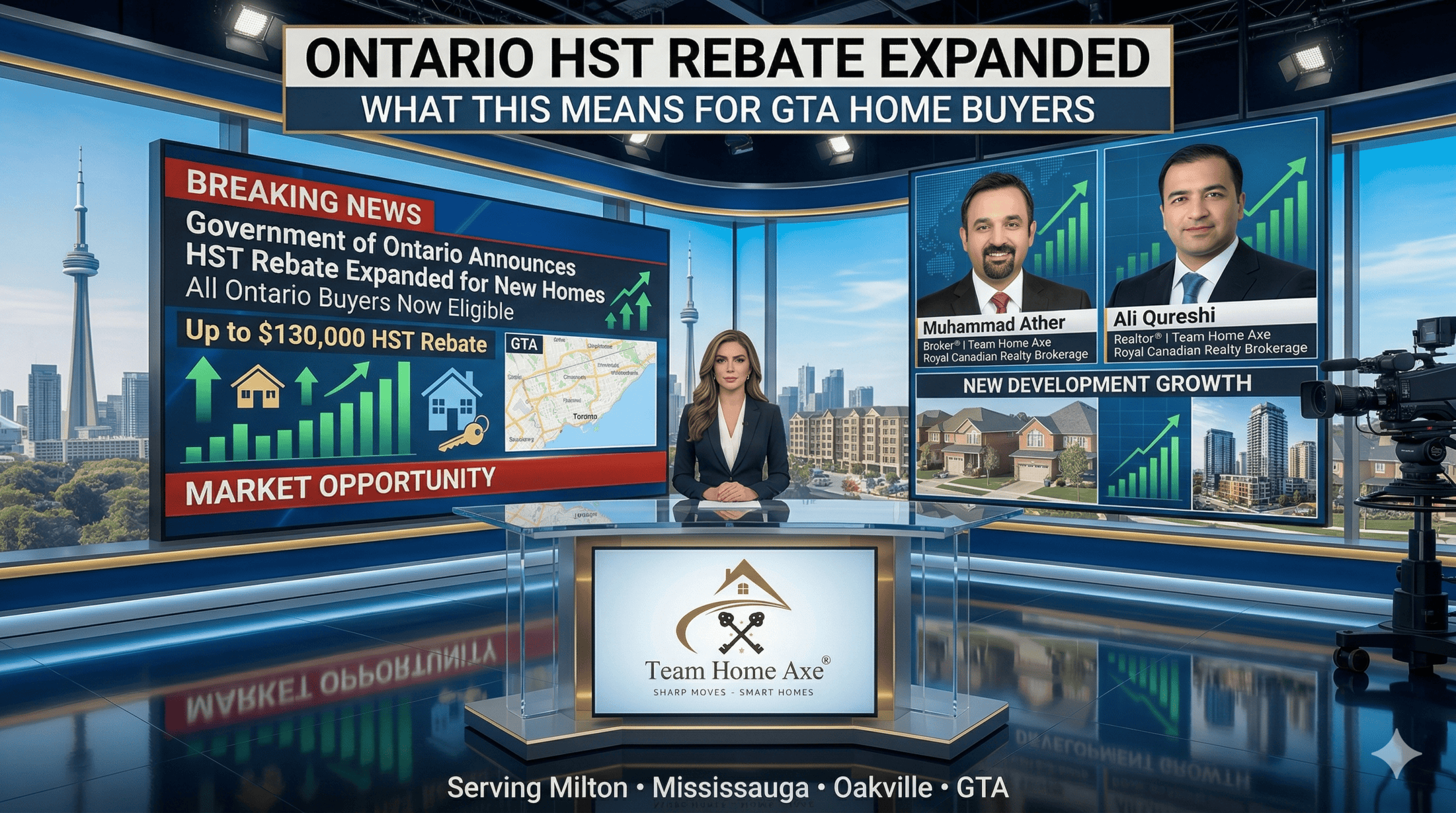
Ontario and the federal government are moving to temporarily expand the Ontario HST rebate on new homes, effectively removing most or all of the 13% HST on many newly built properties for one year for eligible buyers. This builds on the existing Canada GST/HST New Housing Rebate and the newer First-Time Home Buyers' (FTHB) GST/HST rebate.
🏠 Key Numbers at a Glance
- Up to $130,000 in maximum HST relief per qualifying transaction
- Available on homes priced up to $1 million (full relief), with tapered relief to ~$1.85M
- Open to all Ontario buyers — not just first-timers
- Window: April 1, 2026 to March 31, 2027 (subject to legislation)
- Projected: ~8,000 additional housing starts and 20,000+ jobs province-wide
For Southern Ontario and the Greater Toronto Area (GTA), this expansion has the potential to pull forward demand — especially for pre-construction low-rise and mid-rise product — while modestly improving affordability. Over the medium term, the measure could increase new-home sales absorption, support additional housing starts, and improve project viability in markets such as Milton, Mississauga, Oakville, Burlington, and surrounding Toronto suburbs.
2. Understanding the HST Rebate on New Homes
Canada's GST/HST New Housing Rebate allows individuals to recover part of the GST or the federal portion of HST paid on a new or substantially renovated home that will be used as their or a relation's primary place of residence. In harmonized provinces like Ontario, a separate provincial rebate can also apply to the provincial portion of HST.
The Federal Component
At the federal level, the standard new housing rebate historically applied in full up to a certain price point, then phased out as the home's fair market value approached a prescribed threshold — with no rebate above that ceiling.
The Ontario Provincial Component
Ontario's existing provincial new housing rebate for owner-occupied homes allows recovery of up to 75% of the 8% provincial component, typically capped at $24,000, and is available even when the federal rebate is lost solely because the property value exceeds the federal $450,000 threshold.
ℹ️ Who Was Eligible — Before This Change
Eligibility was restricted to individuals (not corporations or partnerships) who purchase from a builder, build themselves, or substantially renovate — provided the property is intended as a primary place of residence.
How HST Is Handled at Closing
When buying from a builder in Ontario, HST is usually included in the advertised purchase price. The builder either:
- Credits the rebate at closing, reducing the amount payable; or
- Leaves the buyer to apply directly to the Canada Revenue Agency (CRA) using specific forms
In practice, most purchasers experience the rebate as a built-in reduction to their HST cost at closing — rather than as a separate refund cheque — though the legal entitlement and paperwork remain with the buyer.
3. What Has Changed in Ontario
The Ontario government has announced that, in partnership with the federal government, it intends to temporarily expand the HST rebate so that all Ontario buyers of qualifying new homes — not just first-time buyers — can benefit from significantly enhanced relief.
📅 The New Policy in Brief
- HST effectively removed on qualifying new homes up to $1 million — both the 8% Ontario portion and the 5% federal portion
- Maximum relief of approximately $130,000 per qualifying transaction
- Same maximum applies to homes between $1M and $1.5M
- Relief declines on a sliding basis between ~$1.5M and ~$1.85M
- Above ~$1.85M, existing rebate rules (including the $24,000 provincial cap) continue to apply
- Implementation window: April 1, 2026 to March 31, 2027 (subject to legislation)
Policy makers have framed this expansion as part of a broader effort to reduce housing costs, spur new construction, and support economic activity in the homebuilding sector — which remains below the pace needed to reach Ontario's target of 1.5 million new homes over ten years. The province estimates the joint federal-provincial initiative could deliver nearly $2.2 billion in combined tax relief for housing.
"The measure could lead to approximately 8,000 additional housing starts and support more than 20,000 jobs, alongside a projected boost to Ontario's real GDP growth."
Ontario Government Estimates, 20264. Who Qualifies for the Rebate
Eligibility under the Canada GST/HST New Housing Rebate framework is rooted in CRA rules. Here's a clear breakdown:
You Qualify If You Are:
- An individual (not a corporation or partnership)
- Purchasing a qualifying property to use as your or a relation's primary place of residence
- Buying a new detached home, townhouse, condo, duplex, or mobile home from a builder
- Signing the Agreement of Purchase and Sale within the one-year eligibility window
First-Time Buyers — Additional Layer Available
The First-Time Home Buyers' (FTHB) GST/HST Rebate adds an additional layer for qualifying first-time buyers, eliminating or reducing the federal portion of HST on new homes up to $1.5 million. It works in tandem with the standard new housing rebate — first-time buyers can effectively layer both programs for even greater savings.
⚠️ Important: Corporations Do Not Qualify
A corporation acquiring multiple new units does not qualify under the individual-only rules, although it may have access to separate New Residential Rental Property Rebates.
📌 Real-World Example
A household purchasing a new townhouse in Milton as their primary residence, where both buyers have owned property in the past, would not qualify for the FTHB rebate — but would still be eligible for the expanded provincial-federal HST relief, provided the agreement is signed during the one-year window and other conditions are met.
Importantly, the measure is expected to apply both to owner-occupiers and to investors purchasing new residential units for long-term rental use, so long as the properties are used as primary residences by the occupants — aligning with existing "primary place of residence" concepts in CRA guidance.
5. How the Rebate Is Applied in Practice
For most buyers in Ontario, the HST rebate is experienced at closing when buying from a builder. Builders commonly include HST in the purchase price and either:
- Credit the rebate to the buyer at closing, reducing the final cash needed (buyer assigns their rebate entitlement to the builder, who claims it from CRA)
- Charge the full HST, leaving the buyer to apply to CRA for the rebate using Form GST190 and related schedules
The expanded Ontario HST rebate new homes policy is expected to follow a similar operational pattern. The buyer's benefit arises either as a reduced purchase-price HST burden or as a post-closing refund — but in both cases, the net effect is lower tax cost on the new home.
Claiming the Rebate Directly
To claim rebates directly, buyers must:
- Submit the appropriate CRA forms within defined deadlines
- Provide documentation including Agreement of Purchase and Sale, statement of adjustments, and proof of occupancy
- Ensure property value and occupancy conditions match the requirements
- Where the FTHB rebate also applies, layer it on top of the standard rebate to maximize federal HST savings
ℹ️ Always Consult a Professional
Buyers should work with their real estate lawyer and tax advisor to ensure all conditions are met and claims are properly filed. Regulations for the 2026 expansion are still being finalized — rely on official CRA guidance and Ministry of Finance resources once published.
6. How Much Can Buyers Save?
The announced Ontario expansion implies significantly larger potential savings than the traditional provincial cap of $24,000, particularly for homes up to $1 million where the full 13% HST could effectively be rebated.
💰 Illustrative Savings Table
Based on indicative policy parameters. Not an official calculator — figures for illustration only. Buyers should rely on official CRA guidance once regulations are finalized.
| Home Price | Approx. HST at 13% | Illustrative Max Rebate | Net HST Cost |
|---|---|---|---|
| $700,000 | $91,000 | Up to $91,000 (full HST) | $0 |
| $950,000 | $123,500 | Up to $123,500 (capped at/below $130,000) | ~$0 to small residual |
| $1,200,000 | $156,000 | ~$130,000 (maximum) | ~$26,000 |
| $1,600,000 | $208,000 | Sliding relief (less than $130,000) | Larger residual HST |
For many purchasers in the Milton Ontario real estate market or Mississauga housing market, the ability to reduce or eliminate a five- or six-figure HST bill on a new home can meaningfully lower upfront cash requirements and overall borrowing needs. In particular, this may improve the feasibility of moving from a condo to a new low-rise home, or from renting to owning a pre-construction unit, during the one-year window.
7. Potential Impact on the Ontario Housing Market
Tax incentives of this scale tend to affect both the timing and composition of housing demand. In Ontario's case, the temporary nature of the expanded HST rebate is likely to pull forward demand for new homes into the April 2026–March 2027 period, as buyers and developers seek to sign purchase agreements within the eligibility window.
- Pre-construction sales absorption rates could increase, particularly for projects that were marginal under previous pricing assumptions
- The province estimates ~8,000 additional housing starts and support for more than 20,000 jobs
- A projected boost to Ontario's real GDP growth is also anticipated
"While the rebate directly lowers tax costs for purchasers of new homes, it may also contribute to upward price pressure if demand accelerates faster than supply responds — especially in constrained markets."
Team Home Axe Market Analysis, 2026Over the medium term, by improving project viability and accelerating launches that might otherwise be delayed, the policy could help add supply to the new-home pipeline — particularly in higher-cost urban and suburban centres. Whether this translates into sustained affordability gains depends on broader macroeconomic conditions, construction capacity, and how quickly new supply reaches occupancy.
8. Potential Impact on the GTA Housing Market
The expanded Ontario HST rebate new homes policy is likely to have differentiated impacts across GTA sub-markets.
Milton, Oakville, Burlington & Toronto Suburbs
In these communities, where new low-rise and mid-rise family housing remains a key growth segment, the ability to remove or significantly reduce HST on new units could make pre-construction townhomes and detached homes more attractive relative to resale alternatives. These markets also benefit from proximity to Toronto employment hubs while offering comparatively larger homes — making them natural targets for policy-induced demand.
Mississauga & Mature Suburban Nodes
Mature suburban nodes with substantial condominium pipelines may see increased interest in new condo launches, especially where pricing has inched toward the $700,000–$1.2 million range. For these buyers, HST relief can materially lower effective acquisition costs — particularly when combined with the FTHB GST/HST rebate for qualifying first-time purchasers.
🗺️ Western GTA Focus: Milton · Mississauga · Oakville · Burlington
The policy may specifically support absorption of new subdivisions, stacked townhome projects, and transit-oriented condo developments that match ongoing population growth and commuter patterns. The Burlington and Oakville markets, which already attract move-up buyers and newcomers seeking suburban family housing, could see heightened activity in the new-home segment during the eligibility window.
Investors Acquiring for Rental Use
Investors acquiring new units for long-term rental could also find projects more feasible — provided they meet primary-residence criteria for tenants and navigate the separate New Residential Rental Property Rebate framework. They will need to carefully assess eligibility, holding-period requirements, and potential clawbacks, as well as local rent regulations and operating costs.
9. Market Context: Southern Ontario Housing Conditions
The expanded HST rebate arrives against a backdrop of:
- Elevated but stabilizing interest rates
- Slower resale volumes than during the pandemic boom
- Ongoing supply constraints in many parts of Southern Ontario
- Strong population growth and immigration — particularly in the GTA and surrounding regions — maintaining long-run demand for both ownership and rental housing
In this environment, tax incentives interact with broader macro forces in complex ways. On one hand, reducing the tax burden on new homes can improve debt-service ratios and down-payment feasibility for households that already have income and savings sufficient to qualify under current mortgage-stress rules. On the other, if rate cuts remain modest and construction costs stay elevated, the rebate may primarily influence which projects proceed and when buyers choose to commit — rather than fundamentally altering affordability for households at the margin of ownership.
10. Strategic Insights for Buyers, Sellers & Investors
For Buyers
For buyers considering newly built homes in the Milton Ontario real estate market, Mississauga housing market, Oakville real estate market, Burlington Ontario housing market, and other GTA communities, the one-year window for enhanced HST relief creates a clear timing incentive. Buyers who can organize financing, due diligence, and product selection to sign agreements within the eligibility period may achieve substantial tax savings — particularly for homes priced up to $1.5 million.
- Evaluate whether you also qualify for the FTHB GST/HST rebate to further reduce federal HST
- Work with your mortgage broker to model the full impact on your down payment and debt servicing
- Prioritize pre-construction opportunities where the rebate can be credited at closing
- Confirm your Agreement of Purchase and Sale is signed within the April 2026–March 2027 window
For Developers & Builders
For developers and builders, the policy can improve presale absorption and project economics, especially for projects that were marginal under prior assumptions or facing slower sales velocity. Projects that can launch or re-position with pricing that maximizes buyer access to the full $130,000 relief may be particularly well-placed in the Western GTA and broader Southern Ontario corridor.
However, there is also a risk that some of the rebate is capitalized into higher prices if supply remains constrained and demand surges — so pricing strategy and product mix will be important.
For Investors
For investors focused on new residential rental units, the expanded rebate — combined with existing New Residential Rental Property Rebate mechanisms — could improve after-tax returns and support more purpose-built rental supply. Investors will need to carefully assess eligibility, holding-period requirements, and potential clawbacks, as well as local rent regulations and operating costs.
11. Frequently Asked Questions (FAQ)
Key questions buyers, sellers, and investors are asking about the Ontario HST rebate expansion:
What is the Ontario expanded HST rebate on new homes?
Ontario and the federal government are temporarily expanding the HST rebate for all buyers of qualifying new homes — not just first-time buyers. During the one-year window (April 1, 2026 – March 31, 2027), eligible buyers can receive up to $130,000 in HST relief, covering both the 8% provincial and 5% federal components.
Do I need to be a first-time buyer to qualify?
No. Under the expanded policy, all individual Ontario buyers of qualifying new homes can benefit — regardless of whether they've owned a home before. However, first-time buyers may also qualify for the FTHB GST/HST rebate as an additional layer of savings.
How much can I save with the expanded HST rebate?
On a home priced up to $1 million, you could save up to the full amount of HST (potentially $91,000–$130,000). The maximum relief is capped at approximately $130,000. Homes between $1.5M and $1.85M receive tapered relief. Above ~$1.85M, existing rules apply.
Does the rebate apply to pre-construction homes?
Yes. The rebate applies to newly constructed or substantially renovated homes, including pre-construction purchases. The Agreement of Purchase and Sale must be signed within the one-year eligibility window for the enhanced rebate to apply.
Can investors use this rebate?
Individual investors purchasing new units intended as primary residences for long-term tenants may qualify. Corporations do not qualify under the individual-only rules. Separate New Residential Rental Property Rebate programs may apply to some corporate or large-scale investor purchases.
How will the rebate be applied — do I get a separate cheque?
In most builder purchases, the rebate is credited at closing, reducing the amount you owe. In some cases, the builder charges full HST and you apply directly to CRA afterward. Either way, the net result is lower tax cost. Work with your lawyer to confirm how your specific transaction will be structured.
Is this policy confirmed, or is it still a proposal?
As of this writing, the measure has been announced by the Ontario government in partnership with the federal government, with communications indicating an April 1, 2026–March 31, 2027 implementation window. It is subject to provincial and federal legislation being passed. Buyers should monitor official announcements from the Ontario Ministry of Finance and CRA for final confirmation.
Disclaimer: The figures and scenarios in this article are illustrative and derived from publicly available policy descriptions. They are not an official tax calculator. Actual savings depend on final regulations, your specific purchase price, eligibility conditions, and CRA guidance once the measures are fully legislated. Always consult a licensed real estate professional, tax advisor, and real estate lawyer before making any purchasing decisions.
Your GTA Real Estate Experts
Team Home Axe
Sharp Moves. Smart Homes.
Our Offices — Serving Southern Ontario
Mississauga
Unit 1 – 2896 Slough St, L4T 1G3
Markham
Suite 206 – 3 Centre St, L3P 3P9
Kitchener
Suite 2B – 625 King St E, N2G 2M2
Hamilton
Suite 300 – 163 Centennial Pkwy N, L8E 1H8
 Toronto Real Estate Board (TRREB); All information deemed reliable but not guaranteed. All properties are subject to prior sale, change or withdrawal. Neither listing broker(s) or information provider(s) shall be responsible for any typographical errors, misinformation, misprints and shall be held totally harmless. Listing(s) information is provided for consumer's personal, non-commercial use and may not be used for any purpose other than to identify prospective properties consumers may be interested
 Data provided by the Ontario Regional Technology & Information Systems. The information is deemed reliable, but is not guaranteed. Not intended to solicit buyers or sellers, landlords or tenants currently under contract.
The trademarks REALTOR®, REALTORS® and the REALTOR® logo are controlled by The Canadian Real Estate Association (CREA) and identify real estate professionals who are members of CREA. The trademarks MLS®, Multiple Listing Service® and the associated logos are owned
Data provided by the Ontario Regional Technology & Information Systems. The information is deemed reliable, but is not guaranteed. Not intended to solicit buyers or sellers, landlords or tenants currently under contract.
The trademarks REALTOR®, REALTORS® and the REALTOR® logo are controlled by The Canadian Real Estate Association (CREA) and identify real estate professionals who are members of CREA. The trademarks MLS®, Multiple Listing Service® and the associated logos are owned
